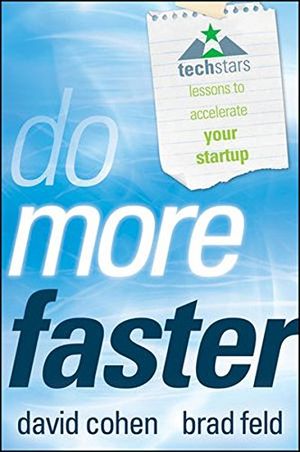
Do more faster
Auteurs :
David Cohen, Brad FeldGenre : Culture et sociétéDate de publication (pays d'origine) : 19 novembre 2010Langue d'origine : AnglaisÉditeur :
John Wiley & Sons Inc.ISBN : 9780470929834Résumé · Do More Faster is a collection of advice that comes from individuals who have passed through, or are part of, Techstars' accelerator programs. Each vignette is an exploration of information often heard during the Techstars program and provides practical insights into early stage entrepreneurship. While you'll ultimately have to make your own decisions about what's right for your business, Do More Faster can get your entrepreneurial endeavor headed in the right direction. It is a cold, hard fact of business life that most startups fail. Even many of those entrepreneurs who ultimately succeed have stories of personal challenges, unsuccessful companies and difficulties along the way. The founders of Techstars have worked with entrepreneurs and companies over the past twenty-five years, and have seen a number of the same issues come up again and again. In Do More Faster, the founders of Techstars identify the key issues that first-time entrepreneurs encounter, and offer proven advice from successful entrepreneurs who have worked with the Techstars program. The authors organize the most critical issues into seven themes: Idea and Vision, People, Execution, Product, Fundraising, Legal and Structure, and Work and Life Balance. Many of the examples are personal experiences from the entrepreneurs themselves, integrated into a cohesive narrative -- while at the same time able to stand on their own. Throughout the book, they debunk numerous myths about startups and reveal some surprising truths. They explain, for instance, that the core of a startup is not always a world-changing and earth-shattering idea -- in fact, it is often the case that successful startups started out doing something else. They also underscore the efficiency of execution: great entrepreneurs know how to synthesize data, make a decision about the path they are going down, and execute. And they offer some alternatives to traditional ways of raising money, while stressing that you shouldn't start with the assumption that you need to raise money. Mastering the seven themes may not ensure success, but understanding the issues, reading the stories and getting advice pertaining to these issues will increase your chances dramatically. And if nothing else, you'll realize that you aren't alone in facing these challenges.Startups do almost everything at a disadvantage. Initially, most startups have less money than their competitors. Startups have less credibility. They have fewer customers. They have fewer employees, which means there are typically fewer people focused on things like marketing, sales, and product development. Resources are scarce at a startup. But, just like in the martial arts, the best startups use the weight of their opponents against them. Bureaucracy slows down larger companies. People do less because making a mistake can be politically costly. Risk takers who are wrong get fired or lose power internally. The larger the company, the more likely it is to be slow. If there's one competitive advantage that most startups have, it's that they can do more faster. And because they can do more faster they can learn more faster. They can immediately throw things away that don't work because nobody cares anyway. Nobody is trying to protect a brand that doesn't exist, and nobody has any reason to be afraid of small failures. Startups know that's just part of the process. When you ask CEOs of major companies what they're most worried about, one common answer is "a couple of guys in a garage somewhere." Why? Because their larger and more established competitors have too much to lose to try something radically different. There's too much at stake for these large companies to try to blow up the market to disrupt the existing players. Relatively speaking, startups have nothing to lose and everything to gain by trying radical or non-obvious things. Larger companies are often baffled at just how much a startup can get done and it scares them. One of the things we talk about with our startups at Techstars is that they simply have to do more faster. This doesn't mean doing random stuff -- they still have to be thoughtful. But if they're not hyperproductive as small, nimble companies, then they're fighting from a real disadvantage. If a startup can't do more faster, it usually gets dead faster.