L'actualité sur A Tale of Two Cities
Les dernières actions



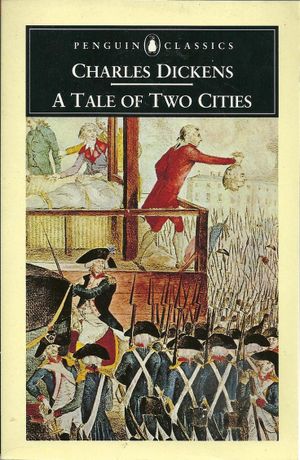
Charles Dickens · 1859
Résumé · This stirring tale of resurrection, renunciation and revolution is one of Dickens's best and most popular novels. Superficially it appears the least Dickensian of all his novels. However, George Woodcok points out that, written at a point of crisis in Dickens's life, it was closely linked with past and present matters of deep personal importance to him. As such, this novel becomes the embodiment of Dickens's own passions, fears and forebodings: the revolution which engulfs the characters symbolizes his own psychological revolution, both as man and artist. The three main characters, Charles Darnay, Sydney Carton, and Lucie Manette, become projections of Dickens himself. And the title, which contains the whole sweep of the author's vision, suggests the basic dichotomy on which the novel rests: the choice between changing society and changing oneself; the gulf between revolutionary ideals and methods; and the duality in the human heart externalized by the Darnay - Carton relationship.
9


Charles Dickens · 1859
Résumé · This stirring tale of resurrection, renunciation and revolution is one of Dickens's best and most popular novels. Superficially it appears the least Dickensian of all his novels. However, George Woodcok points out that, written at a point of crisis in Dickens's life, it was closely linked with past and present matters of deep personal importance to him. As such, this novel becomes the embodiment of Dickens's own passions, fears and forebodings: the revolution which engulfs the characters symbolizes his own psychological revolution, both as man and artist. The three main characters, Charles Darnay, Sydney Carton, and Lucie Manette, become projections of Dickens himself. And the title, which contains the whole sweep of the author's vision, suggests the basic dichotomy on which the novel rests: the choice between changing society and changing oneself; the gulf between revolutionary ideals and methods; and the duality in the human heart externalized by the Darnay - Carton relationship.
8
SensCritique dans votre poche.
Téléchargez l’app SensCritique.
Explorez. Vibrez. Partagez.


À proposNotre application mobile Notre extensionAideNous contacterEmploiL'éditoCGUAmazonSOTA
© 2026 SensCritique
Thème