« At noon on the fifth day, a Lockheed Ventura swung in low and he shotted us, a young pilot, lot younger than Mr. Hooper bere, anyway he spotted us and a few hours later a big ol' fat PBY come down and started to pick us up. You know that was the time I was most frightened. Waitin' for my turn. »
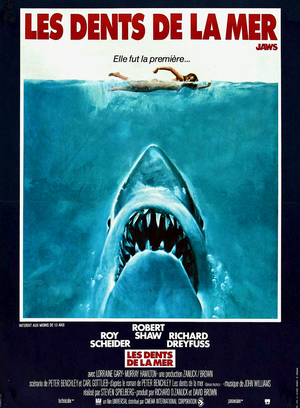
It's the early 70s. The arrival of the so-called "New Hollywood" and films such as The Godfather or The Exorcist turned the film industry upside down. But in 1975, a young director still unknown to the general public did the impossible and shocked the world by adapting Peter Benchley's bestseller for the big screen, which traumatized an entire senecation. I’m talking, of course, about the absolute masterpiece, Jaws.
I. HOW TO DEVOUR HOLLYWOOD
I. THE BIRTH OF A MYTH
We are in 1971. Peter Benchley, White House speechwriter and writer for the Washington Post, gazes out at the horizon on the beach, and thinks back to an article he'd read a few months earlier about a two-ton great white shark caught off Long Island, and ponders: what if a great white shark came along, and decided to stay? Thus was born Jaws, the author's first novel and a huge bestseller.
Meanwhile in Hollywood, producers Richard Zanuck and David Brown are looking for novels that could be adapted for the big screen. After devouring Peter Benchley's novel overnight, the directors were convinced that it would make a good film, and fought to obtain the tights to the book, and to get Universal, where their offices are located, to finance the film. After much negotiation, they get what they wanted, and all that remained was to find a director. They want an experienced director, because shooting at sea is complicated to manage. They first thought of John Sturges, but it didn’t work out.
They then thought of Dick Richards, but the meeting with the producers went badly, as the director's unfortunate tendency to use the word « whale » to designate the film's shark made it difficult for them to reach an agreement. But one day, they think of a young directer with whom they have just collaborated on the film "The Sugarland Express", Steven Spielberg. Spielberg was intrigued by the project, but became more skeptical after reading a manuscript of the novel, as be felt the story had too many sinilarities with his first film, "Duel". He finally agreed to the proiect at the end of 1973. The young director didn't even have a precise vision of the film, but began to write his own script, in order to form his own vision of the proiest, while Benchley worked on writing the film. But there was one last problem, and not the least, that of the shark itself. Although the producers thought it was possible to tame one, they had to face reality, and Joe Alves, artistic director of the movie, had to found a solution. He therefore imagined a life-size shark that could operate in water, but given the technology available at the time, this looked complicated.
Spielberg suggested filming real sharks, to give the film a touch of realism, so 2 Australian divers went to Australia to film some, and a dwarf was placed in the shark cage, the one in the film being supposed to be over 7m long.
Meanwhile, Joe Alves contacted a number of people, but they all refused. He then contacted Bob Matty, who had designed the giant squid in "Twenty Thousand Leagues Under the Sea". He was interested in the project and set about designing the fake shark. Bob's system proved complicated, but feasible. Meanwhile, Benchley continued writing the script, taking into account Spielberg's modifications, but it still didn't suit the director. Benchley's two versions were not to the director's liking, so production began looking for a new director. Meanwhile, Joe Alves went in search of the perfect location for the film, and found the small island of Martha’s Vineyard, off the coast of New England. However, the production rushes the start of shooting due to their dissatisfaction with the length of the film's pre-production.
With the script still not finalized, Spielberg called on his friend Carl Gottlieb, who in turn rewrote the script, and was also given a small role in the film. The rest of the cast fell into place: Roy Scheider was hired for the lead role of Martin Brody, but with two weeks to go before the film was ready of the film's production, there was still the question of who would play the roles of Quint and Hooper. Spielberg chose Richard Dreyfuss for the role of Hooper on the advice of his friend George Lucas, who had previously cast him in "American Graffiti", and 5 days before shooting was due to start, Englishman Robert Shaw was cast as Quint. And so, with a budget estimated at around 3.5 million dollars, the shooting of Jaws is officially underway, and it's not going to be easy.
II. CREATING THE MYTH
In truth, the start of the shoot went rather well. Despite a few difficulties, notably linked to the island's severe restrictions, filming got off to a good start, as it was the scenes on the island that were shot first. But then came filming at sea, and all hell broke loose. On the very first day of shooting, an actor fell into the water and the sound engineer was hit by a huge wave, putting an end to the day's shooting. Then came the start of shooting Act III of the film, recounting the three men's battle with the shark. Except for a small problem: the shark wasn't ready, so the shoot was delayed yet again. And so all hell broke loose - a nightmare for the entire film crew. The colors of the sky were constantly changing, and the currents and waves of the sea prevented the filming from going smoothly.
There were even days when the crew had to leave without any footage, and even one day when the boat sank.
But the biggest difficulty remained the shark itself ; in fact, the latter had never yet been tested in real conditions and it hardly worked.
In addition, many tensions appeared between the actors.
This part of the film alone caused the film's budget to triple.At the end of July 1974, Sidney Sheinberg, then chairman and CEO of Music Corporation of America (which at the time owned Universal Pictures), summoned Spielberg, the director, as well as Zanuck and Brown, the producers, in order to have an explanation on the delay in filming and budget overruns. He threatens to end the project if the problems are not resolved as quickly as possible. The filming was a real ordeal for the entire film crew, but the shark finally worked, and all that remained was to shoot the last shot, that of the shark exploding.
Fortunately, the strike announced by the Screen Actors Guild is called off. Outdoor filming ended definitively on December 15, 1974, after 155 days of shooting. The initial budget was largely exceeded, but without damage when we know the extraordinary box office performance that the film will have. Once filming was completed, Steven Spielberg gave the green light to John Williams to compose the music for the film. Spielberg suggested that he soften the violent scenes of the film with calm music, or even the piano to represent the shark, but the musician did not agree with this and imagined something more invigorating and would demonstrate a great inventiveness, but we will talk about it in more detail later.
Editing was done by Verna Fields who, with Spielberg's help, found suggestions to suggest the shark, due to the problems associated with it. In fact, it only appears after about an hour and a half, but we'll talk about that later too. A test screening was carried out before the film was launched, and it caused a sensation: people stood up, shouted, applauded... III- THE MYTH IS BORN Jaws was released on American screens on Friday June 20, 1975 on a limited circuit of 409 screens, which increased to 464 screens on Friday July 11, then 675 on Friday July 27. The film collected $7,061,513 in its first weekend in the United States. At this speed, the $12 million budget is reimbursed in a few days. Just one month after its release, the film has already grossed around sixty million dollars. During the month of August, Jaws was the first film in the history of cinema to exceed the symbolic milestone of $100 million in revenue in the United States. At the beginning of September, it approached $125 million in the United States. He will end his career with 260 million dollars on the American market and 210 million in the rest of the world. Currently, it is in 56th place in the world historical box office, or even in 7th place if we take into account inflation. A commercial success therefore, but also critical, despite some remarks on the artificial side of the fake shark. Jaws is considered the first blockbuster in the history of cinema, launching the "Hollywood High Concept" and the fashion for summer blockbusters, a method still in force today.
II. AN ALIGNMENT OF THE STARS I. A MASTERFUL DIRECTION Jaws tells the story of three men who go on the hunt for a man-eating shark terrorizing the small island of Amity.
The film opens with a subjective view of the shark swimming in the waters of the island, the title of the film appears over the seaweed accompanied by John Williams' famous theme. The legendary first scene of the film follows: friends having fun on the beach, a couple moving away, the young woman goes to swim naked in the dark waters while her drunken boyfriend falls asleep on the beach. Subjective view of the shark below the woman, the music intensifying as the beast gradually approaches her. Then comes the attack, a moment of calm, then comes the attack again, chilling screams, then absolute silence. With this opening scene, Spielberg lays the foundations of his direction with suggestion, helped by the music announcing the presence of the shark. Spielberg has fun throughout his film suggesting to us a presence, invisible on screen, but definitely there, capable of emerging at any moment. From one of the very first shots of the film, when Martin Brody, the main character of the film, goes to pick up the phone, but realizes that it is not the one there that is ringing, but in reality the one below, outside the camera field. Later comes the beach scene and the death of young Alex Kitner. This scene is a real lesson in directing, and perfectly sums up the ideas of its director, so let's analyze it together. In this scene we are from the point of view of Chief Brody, placed at the top of the beach, having an overview of it. He is already aware of the death of Chrissie Watkins, the young woman from the beginning of the film, but no one else on the beach is because of the mayor's ban on informing the population and closing the beaches. People therefore bathe without any fear and Brody waits for any attack. Spielberg uses the characters passing in front of the camera to make transitions between shots which gives the impression that the action is happening in real time and gives an almost documentary appearance. He films several bathers, but only focuses on one, little Alex. He unknowingly announces to us the shark's next victim and gives us empathy for him in order to reinforce the emotional aspect of the scene. A man comes to speak to Brody, but he only half-listens, and Spielberg illustrates this by using the double lens, a lens used to focus both in the background and in the foreground. Then transition this time much more abrupt and subjective shot of the shark accompanied by music by John Williams, the threat is there. Alex's inflatable raft flips over, a pool of blood spreads in the water, an dolly-zoom on Brody's face highlights his horror at the situation, and panic on the beach. Here is how, in summary, Spielberg gives a real lesson in directing and intelligently succeeds in increasing the tension while traumatizing us for life by making us more want to put a foot in the water, in just a few minutes. Spielberg also uses other directing methods to suggest the shark, such as the wooden bridge in the fishermen's scene, or the barrels in the third act. But the most present and effective method is the music. II- THE SOUNDTRACK In the film, the orchestra has two main functions. First the classic one of musically describing the deep thoughts of the characters, like a “stream of consciousness”, for example at the moment when Chief Brody is admonished in public by the mother of little Alex M. Kintner, the 3rd victim. Then the original one of giving substance to the main character of the film: the shark. Because if we quickly understand who the monster is and we hear a lot about him, until the middle of the film, he does not appear for a single second on the screen. It is only after the 5th victim, a man on a boat, that we begin to see him. And again, furtively and in part. First it's just a silhouette sliding underwater, then later a fin protruding from the waves, and finally a gaping and murderous maw, but almost at the end of the film. To give it substance, John Williams developed repetitive, obsessive music, made up of just two notes, E and F. This theme reveals two other characteristics that we will find in the music throughout the film: the main motif is repeated endlessly in a crescendo and the end of the piece is tense and brutal, without a bridge (transition) with the scene next. This strange way of moving directly from one scene to another without transition in editing and music is due to Spielberg's desire to draw inspiration from the methods of the New Wave. The director was not initially very convinced of the very simple motive of the theme, but once put in condition with the scenes, it is crazy effective. During the scene on the beach where two children create a panic when they simulate the presence of a shark, no music is heard until it actually appears in the lagoon. During the shark hunt, while John Williams had given a sound identity for each character, he had fun blurring the sounds before deploying all the power of his orchestra in the most dramatic scenes. Then, in a striking twist, he stops the music abruptly during the death of Quint, one of the high points of the film. In this sequence where the shark has never been so present, it no longer needs to be represented in music, the spectator no longer having to imagine imminent danger, but to watch a man being devoured. The danger is no longer of the order of fantasy but is indeed real, which explains on a visual level the large quantity of blood seen on the screen, and on a sound level the sounds of objects sliding or colliding with each other. against the others (the boat sinking at this point in the film). Finally, John Williams, who has sometimes been accused of using too much of the fireman style (thundering, theatrical, dramatic, sustained music), also knows how to show humor as when the tourists arrive on Amity Island for the party national 4th of July. While they are aware that a shark has claimed victims, they think that amateur fishermen have caught it and that they are safe. Some will even tag the island sign, out of derision. Matt Hooper, Quint and Martin Brody know well that the murderous shark continues to prowl. The composer translates this atmosphere through old-fashioned and offbeat music, using harpsichords in the style of Bach.
Each character also has their own instrument, for example for Brody, the xylophone which represents childhood and its related fears, which gave him this fear of water. This is also another interesting aspect of the scenario and often overshadowed, the characters.
III. SIMPLE STORY, COMPLEX CHARACTERS Martin Brody: He is known to be married to Ellen and has two children, Michael and Sean. He also says he is from New York (before discovering the body of the first victim) and that this is the first time he is chief of police in Amity (says the mayor during the cub scene). He shows initiative by automatically closing all the beaches, but has no particular respect for authority (see his permanent confrontation with the mayor). He knows absolutely nothing about sharks, which is why he gets information from scientific books, and has a certain courage: although having a holy horror of water, he goes hunting for sharks on the high seas, showing a immense courage. « I used to hate the water. -I can imagine why ». Bart Quint: He is a lonely man, he wants to hunt the shark alone, and demands 10,000 dollars in exchange for the shark, and not 3,000 as Mrs. Kintner suggests. Unpredictable when he breaks the Orca's radio with a baseball bat and confident when he makes fun of Matt Hooper's anti-shark cage, certain of the validity of his methods. But he is also a good-natured person who has a sense of humor as during his frank laugh with Matt Hooper during the scar comparison sequence. He can also be stubborn and authoritarian, returning to port at full speed at the risk of blowing up the machines. He is an old sea dog fascinated by sharks, the walls of his fisherman's hut are covered with the jaws of this animal. Above all, he has a hatred towards them and a revenge to accomplish, he will explain the origin to us in his extraordinary and almost entirely improvised monologue on the subject of the sinking of the Indianapolis. Matt Hooper: He is a scientist specializing in sharks, having seen in his youth a baby thresher shark a meter and a half long tearing up a boat in front of him, which he explains during the meal at the Brody's. We know that he comes from a scientific institute on the continent, without knowing the name, and that he was called to the rescue by the mayor. When faced with sharks, his scientific attitude contrasts with that of Quint, who is more pragmatic, based on experience. Finally, he is a smiling man who likes to joke: during the scar comparison sequence, he says that the worst of his wounds was that of Mary Ellen Moffit who broke his heart. Cultivated, polite, calm but also narrow-minded. Larry Vaughn: He is the exact opposite of Martin Brody. Where Brody is pessimistic, Vaughn remains optimistic, where the first wants to close the beaches preventively, the second wants to leave them open, even when events prove him wrong. Above all, he fears that tourists will no longer come or leave his island. He doesn't like at all that the town's sign is mocked by tourists when one of them is repainted with a shark's fin and the words "help shark!". He does not hesitate to lie, for example by wanting to describe the death of the first victim as an “accident caused by a propeller”. Obstinate, manipulative, in the public meeting he accepts that the beaches are closed... for twenty-four hours only, which he had neglected to tell Brody. He can be human, like when Brody gets slapped by Mrs. Kintner or giving him the green light to hunt the shark, thinking about his own children, but he is obsessed with money and constantly minimizes the danger. His speech is strangely still relevant today...
CONCLUSION. In conclusion, Jaws is still to this day an immense masterpiece, a timeless work, which has crossed and marked the eras, and the film which made me love cinema.