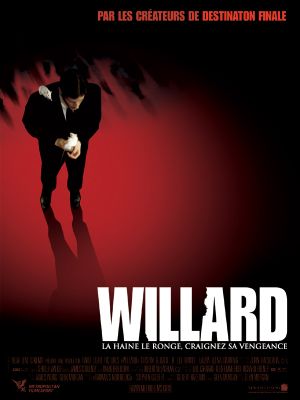
Willard is a strange film. Truly strange. One of those movies where you are never quite sure whether the director made exactly what he wanted or whether everyone simply lost their minds during production. It has atmosphere, personality and Crispin Glover in full force, but it is also so twisted, uncomfortable and over the top that it is hard to know whether it works as horror, black comedy, outsider drama or rat-filled delirium.
The story follows Willard Stiles, a lonely, repressed and socially awkward man who lives with a sick, domineering mother, endures humiliation at work and finds in the rats in his house the only form of companionship and power he has. From there, the film builds a kind of descent into madness where the rodents become friends, army, revenge and a reflection of everything the protagonist cannot control.
Crispin Glover is, without a doubt, the best thing in the film. He is also one of the main reasons it feels so strange. His performance seems to come from another planet: unhinged looks, stiff gestures, a broken voice, a contracted body, a mixture of frightened child, damaged adult and developing psychopath. It is not a “normal” performance, and it does not need to be. Glover turns Willard into someone unpleasant, pathetic, disturbing and, at times, almost sad. The question is whether the film always knows what to do with that intensity.
Because Willard has a clear problem: it wants to be many things at once, and not all of them fit. As a horror film, the rats are not as scary as they should be. They are uncomfortable, yes, and some images are disgusting, but they never create real fear. As a psychological drama, it has an interesting basis in humiliation, loneliness and resentment, but everything is so exaggerated that the emotion is half buried under the artifice. And as a cult oddity, that is where it works best, because the film has a personality that is hard to confuse with anything else.
The tone is the most disorienting thing. Some moments seem to aim for old-fashioned horror: a decaying house, a damp basement, something lurking in the dark. Others feel like a cruel fable about a man who has been stepped on for too long and finds power in the place where there was only misery. And others feel like a macabre joke nobody bothered to explain. That mixture can be fascinating if you enter the game, but it can also leave you outside, staring at the screen and wondering what on earth you are watching.
Visually, however, it has a certain taste. The house, the office, the muted colors, the sense of emotional and physical dirt — all of it helps create a closed, unpleasant world. Glen Morgan does not make a flat film. There is aesthetic intention, atmosphere and a clear desire to turn the story into something more stylized than a simple rat festival. The problem is that the plot is quite weak and does not always support so much eccentricity.
R. Lee Ermey works very well as the abusive, unpleasant boss, almost a caricature of cruel authority. Laura Harring appears as a possible kind presence in Willard’s life, although her character feels underused. In reality, everything revolves so much around Glover and the rats that anything else feels secondary.
Willard does not seem to me like a fully good film, but it is not a vulgar one either. It is too strange to be forgettable. The director and Crispin Glover may have lost their minds, yes, but at least they did it with style. It has unsettling moments, ridiculous moments and moments that are genuinely fascinating because of how twisted they are. It is not very scary, not very moving and narratively not much, but as a strange object it has its appeal.
A film to watch more out of curiosity than real pleasure. If you feel like seeing an oddity with rats, a decaying mansion and Crispin Glover doing Crispin Glover cubed, it may hold some interest. If you are looking for a genuinely effective horror film, it will probably fall short.