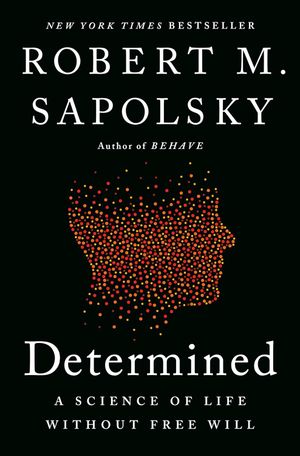
Robert Sapolsky wrote Determined with two main objectives: to convince readers that free will does not exist and to argue that, as a result, the judicial system should function differently. To support these claims, he draws on a wide range of evidence from neuroscience, social sciences, and physics. The book is structured in two main parts, each divided into two sections.
The Case Against Free Will
In the first part, Sapolsky sets out to demonstrate that free will is an illusion. He explains how decisions and opinions are formed in the brain, describing how neurons respond to external stimuli, triggering other neurons in a chain reaction that ultimately leads to an action or a thought. Within this framework, he defines free will as the activation of a neuron for reasons that are neither deterministic nor random—a particularly high bar, but one rooted in the neuroscience of behavior.
Sapolsky then categorizes believers in free will into two groups: those who accept that the world is deterministic and those who do not. To the first group, he points out the contradiction between determinism and free will—if the world is entirely deterministic, then free will, by definition, cannot be. He further argues that our decisions are shaped by our genes, past experiences, and current environment, leaving little room for true autonomy. His hope seems to be that both the logical contradiction and the overwhelming evidence of how our actions are conditioned will persuade deterministic free-will believers to abandon their stance.
For those who reject determinism, Sapolsky addresses the basis of their two main counterarguments: chaos theory and quantum physics. He explains chaos theory in an accessible way, showing that while it introduces unpredictability, it remains entirely deterministic and thus leaves no space for free will. He then brilliantly simplifies quantum physics, demonstrating that while it does introduce randomness at a subatomic level, this randomness is insufficient to drive conscious decision-making. Moreover, he concedes that in the very unlikely case that it actually could influence conscious decision, it would result in erratic, unpredictable behavior—hardly the kind of intentional control associated with free will.
The Implications of a World Without Free Will
The second part of the book explores the consequences of free will’s nonexistence, focusing on morality and the judicial system. First, Sapolsky examines whether rejecting free will also means rejecting morality. He argues that it does not, though his discussion is somewhat diffuse, often addressing religion rather than free will itself. He uses social science research to show that atheists—who, he suggests, are more likely to reject free will—are not morally worse than religious people.
When it comes to the judicial system, Sapolsky makes a strong case against punishment. In a world without free will, retributive justice makes no sense; instead, the justice system should focus on rehabilitation and societal improvement rather than punishment for its own sake. (I'm greatly simplifying his argument here, but this is the core idea.)
Overall, Determined is a fascinating and highly engaging book. Sapolsky writes in a conversational, almost oral style that makes complex topics both entertaining and intellectually stimulating. His ability to explain intricate concepts—especially chaos theory and quantum physics—in an accessible way is truly impressive. This was the first time I felt I actually understood something about these topics.
The book still left one question unanswered for me: why do so many people across diverse societies believe in free will if it does not exist? I would've enjoyed a conversation about why the illusion of free will might be a very functional one.
I highly recommend this book. It’s a great learning experience, a stimulating read, and an enjoyable time all in one.