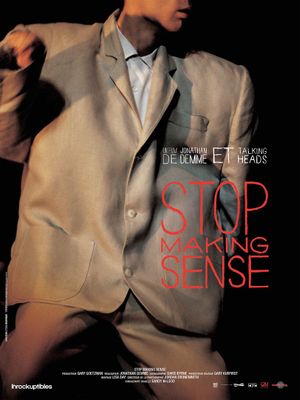
In the beginning was the twitch. And the twitch was with Byrne, and the twitch was Byrne.
I should only believe in a God that would know how to dance.
Watch:
a man dissolving
into his own nervous system
while a lamp
bears witness
Demme understood something about the American body in 1984: that it had forgotten how to be a body. So here are nine humans teaching us to reinhabit our skin through calculated spasms, through the careful accumulation of sound until the stage becomes a living organism, breathing polyrhythm.
I've seen God. She lives in the space between Bernie's hands and the keys. In the bass that grows from Tina's hip like a second spine. In the way Chris makes violence into timekeeping.
What devastated me in this masterpiece: how architecture becomes a damn choreography. Byrne's big suit—Psycho Squarejacket finally admitting we're all just frightened children wearing our fathers' ambitions. Or, as he might reply to such an analysis: "because the big suit is really fucking funny". Behind them, the projections: dismembered mouths, floating torsos, the visual detritus of late capitalism having a nervous breakdown (Onions. Airplane crash. Drugs. Cable TV. Burnt toast. Beautiful view.) These aren't decorations for Making Flippy Floppy. They're cave paintings for the post-industrial age.
Two voices, Lynn and Ednah, arrive; and they change everything. Suddenly Byrne isn't alone up there performing his beautiful isolation. The backing vocals make the songs remember they were meant to be shared.
When they sing with him
the stage becomes less like
a performance space
more like
a laboratory where people
actually make music together.
My holy trinity:
Heaven (where nothing happening sounds suspiciously like three minutes and fourty-one seconds of something definitely happening)
What a Day That Was (Byrne autistically inventing a new way to fall apart)
Burning Down the House (hell yeah)
The genius is in the refusal. No narrative and no psychology. Just bodies remembering they are bodies, remembering they can make noise, remembering that noise can make meaning can make nothing can make everything.
The lamp stands there
like consciousness itself:
unnecessary, essential,
watching us watch ourselves
forget how to pretend
Water runs through everything—once in a lifetime, at the bottom of the ocean, letting the days go by—because the Talking Heads know (and make you understand) we're all drowning in time anyway. Might as well dance while we sink.
This is what Demme caught: the last moment before irony ate itself. Nine people who found a way to be both completely artificial and completely alive. Who made thinking look like dancing and dancing look like thinking. I can only dream of making a film like this one day.
The lamp remains. Still watching. Still questioning whether any of this happened, or whether we dreamed ourselves into being there, in that beautiful house, with our beautiful girlfriends, wondering how we got here, knowing we've always been here, knowing we'll never leave.